Why is Trump so chummy with Cruz?
avatar

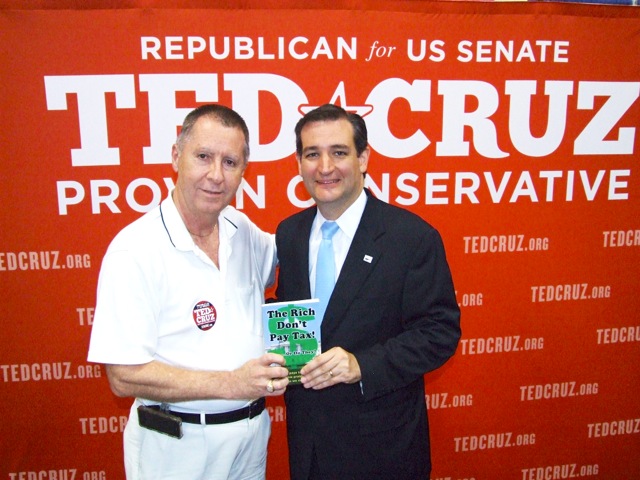
Author John Gaver and then candidate Ted Cruz
Author John Gaver and then Senate candidate Ted Cruz

Bias Statement: When writing about candidates, I believe that authors should include a bias statement, indicating the author’s possible bias. So here is mine. I campaigned for and voted for Ted Cruz for the U.S. Senate (see above photo). I think he has been an acceptable Senator. My choice for President is Mike Huckabee.

Many people were surprised to see Donald Trump being so chummy with Ted Cruz, at the recent CNN GOP Debate, only days after he suggested that Cruz is a “little bit of a maniac”. But, as with everything that Trump does, there is a method to the madness.

As this is being written, Ted Cruz is polling at a very distant second (less than half of Trump’s numbers) in the GOP Primary race. The RCP (Real Clear Politics) aggregate, going back almost three weeks, has Cruz at a mere 16.1% to Trump’s 33%. More recent polls, (Monmouth and ABC News/Washington Post/Langer Research) show Trump with even higher numbers and Cruz with even lower numbers. But despite this huge gap, the Cruz campaign and the media are trying desperately to paint the race for the GOP nomination, as still being up for grabs. Interestingly, even Trump is being nice to Cruz. This is obviously because he needs the continuing media coverage that having a viable challenger gives him. Carson is effectively out and Rubio is fading. So since Trump needs to be seen as having a viable challenger, Cruz suddenly becomes necessary to the Trump campaign.

As it turns out, Cruz is the ideal candidate for this role and the reason comes down to experience. Actually, any of several candidates would have worked. But Cruz is the survivor. Trump knows that, of all of the candidates on the GOP primary ballot, Cruz, Rubio, Paul, and Carson have, by far, the least executive management and budgetary experience, meaning that they will be easiest to defeat, as the primaries get closer. Rand Paul never had a chance, Ben Carson is in a nose-dive, and Marco Rubio is fading. That leaves Cruz. He is the one candidate that Trump knows he can most easily defeat, in a one-on-one race. Let’s look at why.

Here is Ted Cruz’s work history, since graduating from Harvard, with a JD (juris doctorate or law degree).

  • 1995: Graduated Harvard with JD
  • 1995: Law clerk to J. Michael Luttig, US Court of Appeals, 4th Circuit
  • 1996: Law clerk to Chief Justice William Rehnquist
  • 1997-98: Private law practice, Cooper, Carvin & Rosenthal
  • 1999-2003: Various positions in George W. Bush campaign and administration, incl. Domestic Policy Adviser, Associate Deputy Attorney General, Director of Policy Planning at the FTC
  • 2003-08: Texas Solicitor General
  • 2008-13: Private law practice, Morgan, Lewis & Bockius
  • 2013-Present: Texas U.S. Senator.

While this background paints a clear picture of a very gifted lawyer, there is nothing in Cruz’s background to even remotely suggest that he has even the slightest experience in Executive Management or in managing any kind of budget. In fact, some of the things that he has said on the campaign trail indicates a significant shortcoming in his understanding of economics. I’ll get to that in a few moments.

There is no doubt that Ted Cruz​ would make an excellent Supreme Court Justice or Attorney General. But nothing in his background suggests that he would have even the most rudimentary ability to manage a TRILLION DOLLAR BUDGET or be able to manage not just the 2,000+ staff in the Executive Office of the President (EOP), but the hundreds of thousands who work in the military and in the various agencies that report to the President. In fact, his total naiveté on economic issues is clearly displayed in his often repeated claim that his flat income tax plan would allow the IRS to be abolished. After all, it doesn’t take a mental giant or economics guru to figure out that, as long as income is taxed, there is no possible way that the IRS can be abolished or even substantially reduced in size. That is clearly shown in this 2.5 minute video. Yet, Ted Cruz continues to repeat this same easily disproved fallacy.

The Presidency is referred to as, “The Executive Branch” for a reason. It’s not a place for OJT (On-the-Job Training). We have seen, for the past 7 years, just what happens when we put a 1st term senator, with ZERO budgetary or executive management inexperience, in the White House. The job requires someone who has succeeded as an executive, either as a governor, mayor of a large city, or in the private sector. That’s NOT Senator Ted Cruz​ and that’s why Trump is suddenly being so nice to him.

Trump cannot afford to be seen as the clear winner too soon. If that happens, then it kills his momentum for the general election race. Trump is doing something that has never been done before. He announced in June, shot immediately to the top of the polls, and has stayed there. He has the momentum. But he needs to keep it. That means that he needs a way to stay in the news, at least through Super Tuesday and possibly beyond. The media knows that making it appear that Cruz is still a viable challenger will insure continued headlines and advertising revenue for them. Trump knows that those headlines will be about him, but only as long as Cruz (or another viable challenger) is in the race. Trump also knows that, as the convention approaches, Cruz will be the easiest of the remaining GOP candidates for him to defeat, due to Cruz’s total lack of executive management and budgetary experience.

Trump is not my favorite candidate. But you have to hand it to him. When it comes to campaigning and controlling the media, he has it all over the rest of the field – Republican and Democrat. I fully expect Trump to win the November election by the widest margin in history and I can think of a lot worse things than a President Trump. After all, if not for Trump, it’s very likely that we would have ended up with yet another Bush, another inexperienced, albeit well intentioned U.S. Senator, or an equally inexperienced and well intentioned neurosurgeon. Since it’s not likely that we will have a conservative and experienced governor, like Huckabee, Trump is a very acceptable alternative. By contrast, the idea of another inexperienced and economically naive 1st term senator in the White House is just plain scary, even if the letter after his name on the ballot happens to be different.

Follow us on social media
Facebooktwitterrssyoutube

President Trump? A foregone conclusion? (an analysis)
avatar

Donald Trump at CPAC

Donald Trump at CPAC (image courtesy of WikiCommons)

“Reports of my death are greatly exaggerated.”

This famous Mark Twain misquote could well apply to Donald Trump’s campaign.

Since the day Donald Trump announced his run for the GOP nomination for President, back in June, political pundits have predicted the demise of his campaign. Yet, Trump has repeatedly confounded the pundits. Although it is generally considered unwise for a candidate to peak too early, Trump rose quickly to the top of the polls and has remained there. In fact, as this is being written, Donald Trump is 20 points ahead of his nearest challenger in the most recent major poll (CNN/ORC). He now stands at a comfortable 36%, with Cruz, Carson, and Rubio in a virtual tie for second place at 16%, 14%, and 12%, respectively (all within the 4.5% margin of error of each other). But that isn’t the whole story.

(Before going any further, I should go on the record as a supporter, not of Donald Trump, but of Gov. Mike Huckabee.)

All of the major polling organizations have built their success on their ability to identify “likely voters”. They begin by asking questions, not only about how likely you are to vote in the next election, but they also ask about when you voted last. The opinions of those who are not considered to be likely voters are not generally part of the final count. They also tend not to contact those who were not considered to be likely voters in previous polls. This strategy has been honed and perfected, over the years and up to now, it has proved to be quite effective.

But all that has changed with the emergence of Donald Trump, onto the political scene. That’s because large numbers of his supporters are people who have either never voted in a national election or have not voted in a very long time – the so-called “disenfranchised voters”. The problem that this represents is that these people are likely to be omitted from the polls, since they do not fit the traditional model of a “likely voter”. Even many polling company executives have admitted that they are not sure how to count these people. It’s a new paradigm. What this all means is that Trump’s real numbers are probably quite a few points higher than the traditional polls would indicate.

Add to all of this the fact that almost all recent presidential elections have been determined by the undecided and independent vote – the “swing voters”. The sole exception was Romney’s loss, which was due almost exclusively to the many Christians, who sat out the election in a snit, because they didn’t consider Romney to be “Christian enough”. But after the last four years, it’s a safe bet that won’t happen again. In general, somewhere in the range of 35 to 40 percent of voters will vote Republican, regardless of who the party nominees are. A similar percentage will always vote Democrat. This means that the winner will be the candidate who gets the most votes from those swing voters. But with Trump in the race, even if the “traditional” swing voters split evenly, Trump wins, because of the large number of “disenfranchised voters” that he brings to bear.

Finally add into the mix that Trump is a master of the media and a master self-promoter. No other candidate, from either party, comes close in either arena. In fact, if you look closely, you can even see how it is really Trump, who selects which candidate will make a temporary rise in the polls. Just about the time you think one candidate will overtake him, Trump says something that brings another second tier candidate to the forefront and his previous leading challenger slips in the polls. Each time this happens, the new challenger takes points mostly from the previous leading challenger. Trump plays the media like Itzhak Perlman played the Stradivarius.

Trump has not only held onto his lead in the primary, but he is widening his lead. Establishment and TEA Party candidates, who were supposed to be in the lead, are barely managing to stay in the race. Jeb Bush, who was the GOP Leadership’s heir apparent and who has, for most of the race, been the most heavily funded candidate, is now barely hanging on to a mere 3% support and is in effective free-fall. Ted Cruz, who was initially considered to be a TEA Party favorite, has had trouble making any headway, following revelations that his immigration plan includes an amnesty provision (legal permanent residency) and his claims that his tax plan will allow the IRS to be abolished – a claim that has been conclusively disproven. Also, Carson and Rubio have each had their turn as the prime Trump challenger, but to no avail.

Another effect from which Trump benefits is one that is often referred to as the “winner syndrome”. In short, what this means, is that people like to vote for a winner and many voters, who think their candidate has no chance, will change their vote in the voting booth, so they can truthfully say that they vote for the winner. As it turns out, Trump is seen as the winner. In order to get a handle on this “winner” effect, the Rasmussen organization, instead of asking respondents who they prefer as the GOP nominee, asks who the respondents think will be the GOP nominee. According to Rasmussen Reports, “The latest Rasmussen Reports weekly Trump Change survey finds that 68% of Likely Republican Voters believe Trump is likely to be their party’s nominee next year…” That’s phenomenal!

Following the advice of Sun Tsu (“The Art of War”), Trump had the war (the election) won, before he stepped onto the battlefield (entered the race). He controls the battlefield (the media) and has a series of feints set up, with which he controls the opposing forces (the other candidates). It’s now becoming clear that even all of his supposed gaffs, were almost certainly well planned feints, intended to move the conversation in the direction he wanted it to go, at the time he wanted it to move that way. Like an experienced general on a battlefield, Trump is drawing the opposing forces (the other candidates) into mine-fields and positions where they can be easily flanked. It’s only a matter of time before the enemy lines (the rest of the field) completely collapse.

In fact, since the party is over, it’s time for Cruz, Rubio, and Paul to drop out and get back to doing what their constituents elected them to do, which is represent them in the U.S. Senate. As a Texan, who campaigned heavily for Cruz, I must say that I am very disappointed that, since Cruz took office, he has spent far more time campaigning, than he has spent representing the people of Texas. I imagine that Rubio’s constituents must feel the same way, while Rand Paul’s constituents have somewhat less to complain about.

Of course, if any of the second or third tier candidates have aspirations of being Trump’s VP or would like to hold some other position in the Trump White House, then they better stop attacking Trump and start pandering to him. After all, since all but Carson and Fiorina are politicians, pandering is what they are really good at, anyway.

This is not an endorsement of Trump. As stated above, my candidate of choice is Huckabee (2%). I would prefer that things were different. But this is just the way it is. Although Trump is certainly not my first choice, I must admit that I would not feel any regret when I have to vote for him in November and that’s more than I can say about most of the GOP field. Trump will be the next President. The only thing left to be determined is, who will be on the inside of the Trump Administration and who will be on the outside.

[Update 12/9/15]

As if to underscore the points made in this article, a new Bloomberg poll shows that two thirds of GOP primary voters back Trump’s Muslim ban and a third of those voters say that it will make them more likely to vote for him. Once again, Trump manipulated the entire situation. He made a statement that was widely reported in headlines, containing his name. Then, as if on queue, the pundits added to the headlines that contained his name, by claiming that the statement would surely sink Trump’s campaign. But in the end, Trump’s supposed gaffe boosted his standing. This is a perfect example of Trump manipulating the media and other candidates, to get “free publicity” and boost his standing, in the process. Once again, Trump enticed the media and the other candidates into a position, where there was no move that would not help Trump.

Follow us on social media
Facebooktwitterrssyoutube